How Long Does It Take to Become an IT Support Specialist?
See if you qualify for IT Support programs
Answer a few questions in 2 minutes. Free, no commitment.
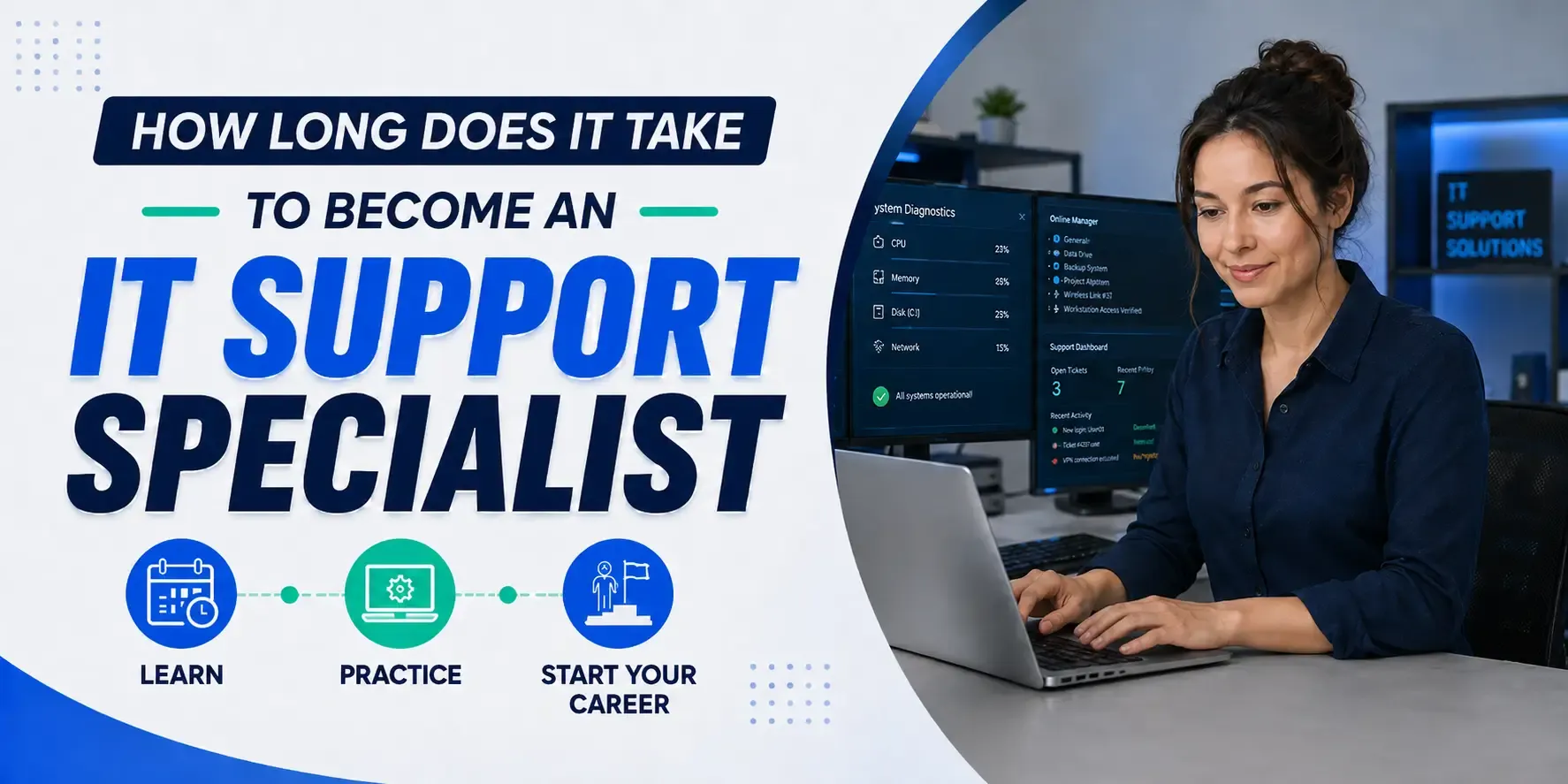
Training to become an IT support specialist can take anywhere from several weeks to about 4 years, depending on the credential you pursue. A short certificate or an entry certification like CompTIA A+ can prepare you to start applying for entry-level roles within a few months, while a degree takes longer. An associate degree runs about 2 years and is often expected for network support roles, and a bachelor's is usually about 4 years from the start, or roughly 2 more years if you transfer in with an associate. IT support is not a licensed occupation, so there is no state license to wait on; your pace is set by how quickly you build skills and earn the certifications employers look for. How long it actually takes to get hired also depends on your prior experience, hands-on practice, and the roles you target.
Computer Information Systems, BS - Arizona State University
- Format: Online
- Accredited by the Higher Learning Commission
Bachelor of Arts in Information Technology - University of Arizona Global Campus
- Format: Online
- Courses run 5 to 6 weeks, taken one at a time
- Accredited by ABET and WSCUC
Dreambound also lists IT bachelor's programs from Southern New Hampshire University, Full Sail University, and Colorado Technical University.
Master's Degree (Advancement)
Master's programs are advancement paths for specialists moving toward management or specialized IT roles. They are not entry points into support work, but they show the longer end of the timeline if you plan to grow beyond a support role.
MS Information Technology - Southern New Hampshire University
- Format: Online
- Length: about 15 months
Information Technology, MS - Arizona State University
- Format: Online
- Accredited by the Higher Learning Commission
Frequently Asked Questions
Is it hard to become an IT support specialist?
It is one of the more approachable tech careers to enter, especially if you enjoy problem solving and working with computers. The core skills, hardware, operating systems, and basic troubleshooting, can be learned in a certificate program or through self-study. The harder part is usually building enough hands-on practice to feel confident on the job, not the coursework itself.
Do you need CompTIA A+ to work in IT support?
Not always. A+ is not legally required, and some employers accept equivalent experience or other certifications. That said, it is one of the most widely recognized entry credentials, so having it can strengthen an entry-level application and signal baseline skills. Many certificate and diploma programs are built around preparing you for the two A+ exams.
Do IT support certifications expire or need renewal?
Some do. CompTIA A+, the common entry credential, is valid for three years from the date you earn it, and you renew it through CompTIA's continuing education program by earning continuing education units, without retaking the exam. Vendor certifications have their own timelines, so check each one's renewal terms.
Can you become an IT support specialist while working full time?
Yes. Many certificate programs and degrees are offered online and self-paced, which lets you study around a full-time job. The trade-off is time, since part-time study generally takes longer than a full-time schedule. Browse IT support programs on Dreambound to compare part-time and self-paced options by schedule.
Planning Your IT Support Timeline
How long it takes comes down mostly to the training path you pick, but prior experience, employer expectations, certification study, and the job search all shape the rest. A certificate and a certification can prepare you to apply for entry-level roles in a few months, while an associate or bachelor's stretches the path to years and opens more technical or higher-level roles. Because IT support is not a licensed occupation, there is no state board setting your pace.
Keep the real finish line in mind. It is not the last day of class, but the point where you have enough hands-on practice to be hired. Building that experience is part of the timeline, which is why even the fastest programs recommend months of hands-on work alongside the coursework.
Compare IT support programs on Dreambound by length and credential to see how a short certificate stacks up against a longer degree, and pick the path that matches the time you have.